
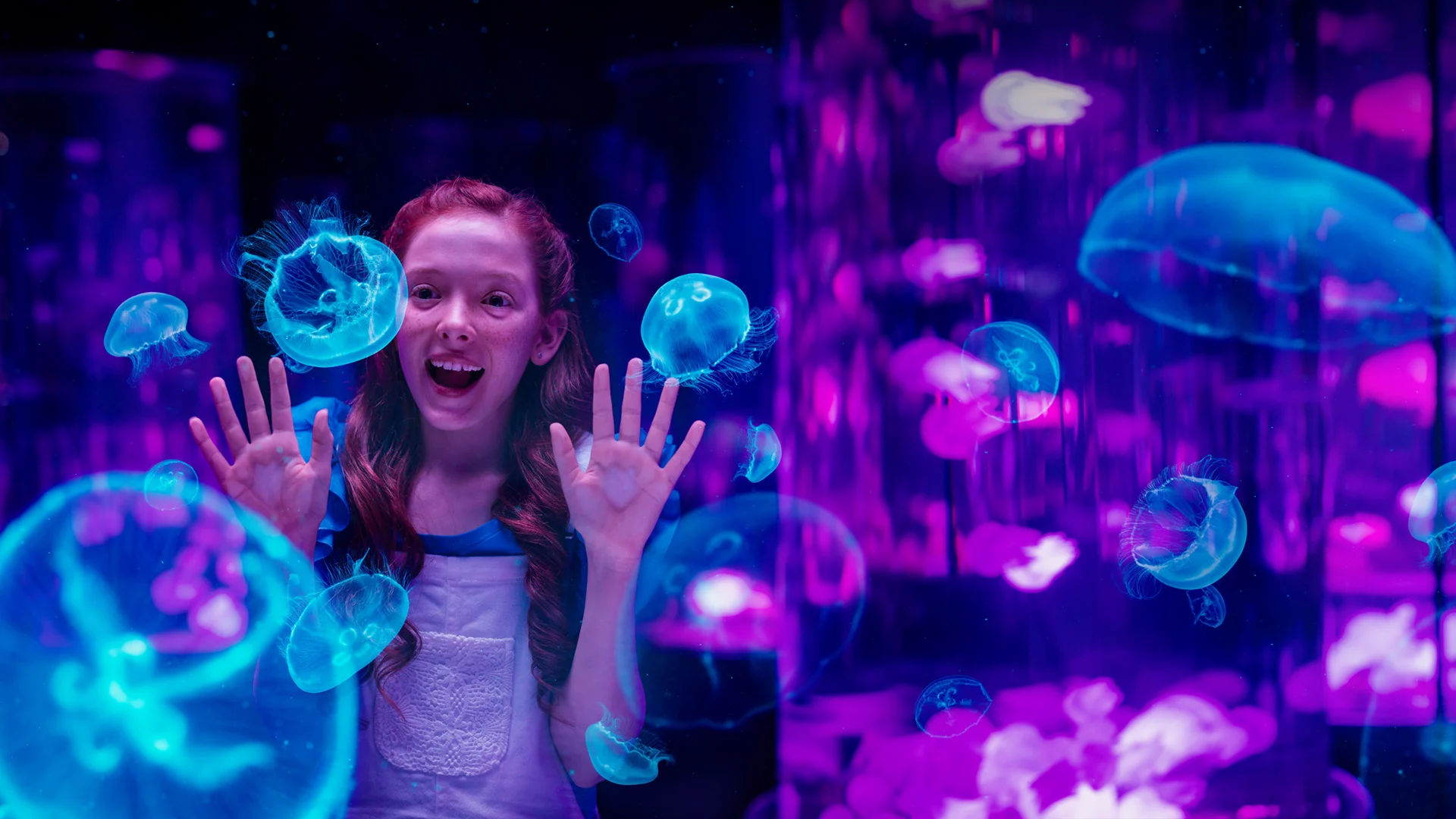
Sea Jellies Illuminated
Experience Sea Jellies like never before with an illuminated backdrop full of colour and life. Plus, learn all about these amazing creatures in the first of its kind operating research laboratory from Griffith University.
Fun Facts about Sea Jellies!
Learn all about the array of illuminated sea jellies as you make your way around the Exhibit

Blue Blubbers
Scientific name: Catostylus mosaicus Distribution: Common in the coastal waters of eastern and southern Australia. Catostylus mosaicusis recognised for its robust, dome-shaped bell and thick, frilly oral arms that radiate from the bell’s underside. Typically displaying shades of blue, white, or brown, the species can form large blooms in estuaries and bays during warm seasons. It has a moderate sting and feeds primarily on plankton, using its mucus-coated oral arms to trap food. Its striking colouration and frequent coastal aggregations make it one of Australia’s most familiar jellyfish.
Blue Blubbers
Scientific name: Catostylus mosaicus Distribution: Common in the coastal waters of eastern and southern Australia. Catostylus mosaicusis recognised for its robust, dome-shaped bell and thick, frilly oral arms that radiate from the bell’s underside. Typically displaying shades of blue, white, or brown, the species can form large blooms in estuaries and bays during warm seasons. It has a moderate sting and feeds primarily on plankton, using its mucus-coated oral arms to trap food. Its striking colouration and frequent coastal aggregations make it one of Australia’s most familiar jellyfish.
Blue Blubbers
Scientific name: Catostylus mosaicus Distribution: Common in the coastal waters of eastern and southern Australia. Catostylus mosaicusis recognised for its robust, dome-shaped bell and thick, frilly oral arms that radiate from the bell’s underside. Typically displaying shades of blue, white, or brown, the species can form large blooms in estuaries and bays during warm seasons. It has a moderate sting and feeds primarily on plankton, using its mucus-coated oral arms to trap food. Its striking colouration and frequent coastal aggregations make it one of Australia’s most familiar jellyfish.
Blue Blubbers
Scientific name: Catostylus mosaicus Distribution: Common in the coastal waters of eastern and southern Australia. Catostylus mosaicusis recognised for its robust, dome-shaped bell and thick, frilly oral arms that radiate from the bell’s underside. Typically displaying shades of blue, white, or brown, the species can form large blooms in estuaries and bays during warm seasons. It has a moderate sting and feeds primarily on plankton, using its mucus-coated oral arms to trap food. Its striking colouration and frequent coastal aggregations make it one of Australia’s most familiar jellyfish.

Lions Mane Jellyfish
Scientific name: Cyanea annaskala Distribution: Found mainly along southeastern Australia, especially New South Wales waters. Cyanea annaskala resembles smaller relatives of the lion’s mane jellyfish, featuring a reddish-pink to orange bell with multiple long, trailing tentacles that can deliver a potent sting. Its bell margin is deeply scalloped, and it possesses numerous oral arms that aid in capturing zooplankton and small fish. This species often appears seasonally in coastal waters, where wind and currents can bring large numbers near beaches. Though visually striking, contact with its tentacles can cause painful welts, making it a jellyfish of concern for swimmers.
Lions Mane Jellyfish
Scientific name: Cyanea annaskala Distribution: Found mainly along southeastern Australia, especially New South Wales waters. Cyanea annaskala resembles smaller relatives of the lion’s mane jellyfish, featuring a reddish-pink to orange bell with multiple long, trailing tentacles that can deliver a potent sting. Its bell margin is deeply scalloped, and it possesses numerous oral arms that aid in capturing zooplankton and small fish. This species often appears seasonally in coastal waters, where wind and currents can bring large numbers near beaches. Though visually striking, contact with its tentacles can cause painful welts, making it a jellyfish of concern for swimmers.
Lions Mane Jellyfish
Scientific name: Cyanea annaskala Distribution: Found mainly along southeastern Australia, especially New South Wales waters. Cyanea annaskala resembles smaller relatives of the lion’s mane jellyfish, featuring a reddish-pink to orange bell with multiple long, trailing tentacles that can deliver a potent sting. Its bell margin is deeply scalloped, and it possesses numerous oral arms that aid in capturing zooplankton and small fish. This species often appears seasonally in coastal waters, where wind and currents can bring large numbers near beaches. Though visually striking, contact with its tentacles can cause painful welts, making it a jellyfish of concern for swimmers.
Lions Mane Jellyfish
Scientific name: Cyanea annaskala Distribution: Found mainly along southeastern Australia, especially New South Wales waters. Cyanea annaskala resembles smaller relatives of the lion’s mane jellyfish, featuring a reddish-pink to orange bell with multiple long, trailing tentacles that can deliver a potent sting. Its bell margin is deeply scalloped, and it possesses numerous oral arms that aid in capturing zooplankton and small fish. This species often appears seasonally in coastal waters, where wind and currents can bring large numbers near beaches. Though visually striking, contact with its tentacles can cause painful welts, making it a jellyfish of concern for swimmers.

Moon Jellies
Scientific Name: Aurelia coerulea Distribution: Native to the western Pacific but now found widely in temperate and subtropical coastal waters due to human-mediated spread.
Aurelia coerulea is a moon jelly distinguished by its translucent, saucer-shaped bell and the characteristic four horseshoe-shaped gonads visible through the bell. It typically reaches moderate sizes, with a soft, gelatinous texture and gently pulsating locomotion. This species tolerates a wide range of environmental conditions, enabling it to thrive in harbours, marinas, and other human-altered habitats. Its mild sting and opportunistic feeding on zooplankton make it an adaptable and sometimes invasive jellyfish in coastal ecosystems.
Moon Jellies
Scientific Name: Aurelia coerulea Distribution: Native to the western Pacific but now found widely in temperate and subtropical coastal waters due to human-mediated spread.
Aurelia coerulea is a moon jelly distinguished by its translucent, saucer-shaped bell and the characteristic four horseshoe-shaped gonads visible through the bell. It typically reaches moderate sizes, with a soft, gelatinous texture and gently pulsating locomotion. This species tolerates a wide range of environmental conditions, enabling it to thrive in harbours, marinas, and other human-altered habitats. Its mild sting and opportunistic feeding on zooplankton make it an adaptable and sometimes invasive jellyfish in coastal ecosystems.
Moon Jellies
Scientific Name: Aurelia coerulea Distribution: Native to the western Pacific but now found widely in temperate and subtropical coastal waters due to human-mediated spread.
Aurelia coerulea is a moon jelly distinguished by its translucent, saucer-shaped bell and the characteristic four horseshoe-shaped gonads visible through the bell. It typically reaches moderate sizes, with a soft, gelatinous texture and gently pulsating locomotion. This species tolerates a wide range of environmental conditions, enabling it to thrive in harbours, marinas, and other human-altered habitats. Its mild sting and opportunistic feeding on zooplankton make it an adaptable and sometimes invasive jellyfish in coastal ecosystems.
Moon Jellies
Scientific Name: Aurelia coerulea Distribution: Native to the western Pacific but now found widely in temperate and subtropical coastal waters due to human-mediated spread.
Aurelia coerulea is a moon jelly distinguished by its translucent, saucer-shaped bell and the characteristic four horseshoe-shaped gonads visible through the bell. It typically reaches moderate sizes, with a soft, gelatinous texture and gently pulsating locomotion. This species tolerates a wide range of environmental conditions, enabling it to thrive in harbours, marinas, and other human-altered habitats. Its mild sting and opportunistic feeding on zooplankton make it an adaptable and sometimes invasive jellyfish in coastal ecosystems.

Tiger Sea Nettle
Scientific Name: Chrysaora pentastoma Distribution: Endemic to Australia
Chrysaora pentastoma is a distinctive member of the sea nettle group, possessing a translucent bell often patterned with radial brownish markings. It features long; slender tentacles and a set of oral arms that help it capture zooplankton and small fishes. Like its relatives, it is an active swimmer well-adapted to open-coastal environments. Its sting is moderately potent and can cause discomfort in humans, but it plays a valuable ecological role as both a predator and a prey species in pelagic food webs.
Tiger Sea Nettle
Scientific Name: Chrysaora pentastoma Distribution: Endemic to Australia
Chrysaora pentastoma is a distinctive member of the sea nettle group, possessing a translucent bell often patterned with radial brownish markings. It features long; slender tentacles and a set of oral arms that help it capture zooplankton and small fishes. Like its relatives, it is an active swimmer well-adapted to open-coastal environments. Its sting is moderately potent and can cause discomfort in humans, but it plays a valuable ecological role as both a predator and a prey species in pelagic food webs.
Tiger Sea Nettle
Scientific Name: Chrysaora pentastoma Distribution: Endemic to Australia
Chrysaora pentastoma is a distinctive member of the sea nettle group, possessing a translucent bell often patterned with radial brownish markings. It features long; slender tentacles and a set of oral arms that help it capture zooplankton and small fishes. Like its relatives, it is an active swimmer well-adapted to open-coastal environments. Its sting is moderately potent and can cause discomfort in humans, but it plays a valuable ecological role as both a predator and a prey species in pelagic food webs.
Tiger Sea Nettle
Scientific Name: Chrysaora pentastoma Distribution: Endemic to Australia
Chrysaora pentastoma is a distinctive member of the sea nettle group, possessing a translucent bell often patterned with radial brownish markings. It features long; slender tentacles and a set of oral arms that help it capture zooplankton and small fishes. Like its relatives, it is an active swimmer well-adapted to open-coastal environments. Its sting is moderately potent and can cause discomfort in humans, but it plays a valuable ecological role as both a predator and a prey species in pelagic food webs.

Upside-Down Jellyfish
Scientific Name: Cassiopea xamachana Distribution: Native to the Caribbean and western Atlantic mangrove lagoons and shallow bays
Cassiopea xamachana is famous for resting upside-down on the seafloor, exposing its symbiotic, algae-filled oral arms toward the sunlight. Its bell is relatively flat and mottled, while its oral arms form a frilly, flower-like structure that pulses gently as it filter-feeds. The photosynthetic algae (zooxanthellae) within its tissues supply much of its energy, allowing it to thrive in warm, shallow, nutrient-poor waters. Although generally harmless, this species can release “stinging water,” a cloud of microscopic venomous structures that can irritate swimmers.
Upside-Down Jellyfish
Scientific Name: Cassiopea xamachana Distribution: Native to the Caribbean and western Atlantic mangrove lagoons and shallow bays
Cassiopea xamachana is famous for resting upside-down on the seafloor, exposing its symbiotic, algae-filled oral arms toward the sunlight. Its bell is relatively flat and mottled, while its oral arms form a frilly, flower-like structure that pulses gently as it filter-feeds. The photosynthetic algae (zooxanthellae) within its tissues supply much of its energy, allowing it to thrive in warm, shallow, nutrient-poor waters. Although generally harmless, this species can release “stinging water,” a cloud of microscopic venomous structures that can irritate swimmers.
Upside-Down Jellyfish
Scientific Name: Cassiopea xamachana Distribution: Native to the Caribbean and western Atlantic mangrove lagoons and shallow bays
Cassiopea xamachana is famous for resting upside-down on the seafloor, exposing its symbiotic, algae-filled oral arms toward the sunlight. Its bell is relatively flat and mottled, while its oral arms form a frilly, flower-like structure that pulses gently as it filter-feeds. The photosynthetic algae (zooxanthellae) within its tissues supply much of its energy, allowing it to thrive in warm, shallow, nutrient-poor waters. Although generally harmless, this species can release “stinging water,” a cloud of microscopic venomous structures that can irritate swimmers.
Upside-Down Jellyfish
Scientific Name: Cassiopea xamachana Distribution: Native to the Caribbean and western Atlantic mangrove lagoons and shallow bays
Cassiopea xamachana is famous for resting upside-down on the seafloor, exposing its symbiotic, algae-filled oral arms toward the sunlight. Its bell is relatively flat and mottled, while its oral arms form a frilly, flower-like structure that pulses gently as it filter-feeds. The photosynthetic algae (zooxanthellae) within its tissues supply much of its energy, allowing it to thrive in warm, shallow, nutrient-poor waters. Although generally harmless, this species can release “stinging water,” a cloud of microscopic venomous structures that can irritate swimmers.

Moon Goddess
Scientific Name: Chrysaora kynthia Distribution: Endemic to Australia
Chrysaora kynthia is a recently described species of sea nettle distinguished by its softly coloured, often amber-tinted bell and long, semi-transparent tentacles. Its bell shape and patterning resemble other Chrysaora species, but genetic and morphological studies have confirmed its unique status. It inhabits warm, oligotrophic waters, where it drifts and pulses through the upper water column while capturing zooplankton with its stinging tentacles. Although not typically forming massive blooms, it is an essential component of the region’s gelatinous zooplankton community.
Moon Goddess
Scientific Name: Chrysaora kynthia Distribution: Endemic to Australia
Chrysaora kynthia is a recently described species of sea nettle distinguished by its softly coloured, often amber-tinted bell and long, semi-transparent tentacles. Its bell shape and patterning resemble other Chrysaora species, but genetic and morphological studies have confirmed its unique status. It inhabits warm, oligotrophic waters, where it drifts and pulses through the upper water column while capturing zooplankton with its stinging tentacles. Although not typically forming massive blooms, it is an essential component of the region’s gelatinous zooplankton community.
Moon Goddess
Scientific Name: Chrysaora kynthia Distribution: Endemic to Australia
Chrysaora kynthia is a recently described species of sea nettle distinguished by its softly coloured, often amber-tinted bell and long, semi-transparent tentacles. Its bell shape and patterning resemble other Chrysaora species, but genetic and morphological studies have confirmed its unique status. It inhabits warm, oligotrophic waters, where it drifts and pulses through the upper water column while capturing zooplankton with its stinging tentacles. Although not typically forming massive blooms, it is an essential component of the region’s gelatinous zooplankton community.
Moon Goddess
Scientific Name: Chrysaora kynthia Distribution: Endemic to Australia
Chrysaora kynthia is a recently described species of sea nettle distinguished by its softly coloured, often amber-tinted bell and long, semi-transparent tentacles. Its bell shape and patterning resemble other Chrysaora species, but genetic and morphological studies have confirmed its unique status. It inhabits warm, oligotrophic waters, where it drifts and pulses through the upper water column while capturing zooplankton with its stinging tentacles. Although not typically forming massive blooms, it is an essential component of the region’s gelatinous zooplankton community.
Learn More about Sea Jellies

Sea Jellies Educational Talk
Want to learn more about these cryptic and fascinating animals that are found all over the globe and don’t even have a brain? Visit Sea Jellies Illuminated, to hear all about the role Sea Jellies play in the ocean.
Want to learn more about these cryptic and fascinating animals that are found all over the globe and don’t even have a brain? Visit Sea Jellies Illuminated, to hear all about the role Sea Jellies play in the ocean.
Partners
Griffith University Research Laboratory
The Griffith Sea Jellies Research Laboratory is a state-of-the-art facility, which places Griffith University at the forefront of jellyfish research. This exhibit provides a glimpse into the ongoing research in the fascinating world of sea jellies.

Surf Life Saving Queensland
Sea World’s partnership with Surf Life Saving Queensland plays an important role in educating communities about aquatic safety and sea jelly stings with the goal of achieving zero preventable deaths in Queensland's public waters.
Griffith University Research Laboratory
The Griffith Sea Jellies Research Laboratory is a state-of-the-art facility, which places Griffith University at the forefront of jellyfish research. This exhibit provides a glimpse into the ongoing research in the fascinating world of sea jellies.
Surf Life Saving Queensland
Sea World’s partnership with Surf Life Saving Queensland plays an important role in educating communities about aquatic safety and sea jelly stings with the goal of achieving zero preventable deaths in Queensland's public waters.